
China trip planning guide
A first-time China itinerary that leaves room for the trip itself
Compare realistic 7-, 10-, 14-, and 21-day China trip shapes, understand transfer tradeoffs, and start a paced itinerary for your first destination.
Reviewed 2026-09-02
Quick answer
Choose the shape before the stops
A good first trip to China gives every stop a clear role, counts transfers honestly, and protects the reservations that can shape the whole route.
- 7 days: one strong base, or two cities with one simple connection.
- 10 days: two cities with depth, or a fast three-city route with explicit tradeoffs.
- 14 days: three contrasting stops, including one nature region when transfers work.
- 21 days: four or five stops following one geographic line, with recovery time.
Start with the number of usable days
Count the days when you can genuinely explore, not only the dates between your flights. An international arrival, a long rail transfer, a hotel change, or an early departure can turn a calendar day into a partial day.
If every city has been reduced to one headline sight and a station transfer, remove a stop.
- 7 days: choose one strong base, or two cities with one simple connection.
- 10 days: choose two cities with depth, or a fast three-city route with explicit tradeoffs.
- 14 days: three contrasting stops become more comfortable, including a city route plus one nature region.
- 21 days: four or five stops can work when they follow a clear geographic line and include recovery time.
Choose what you want China to feel like
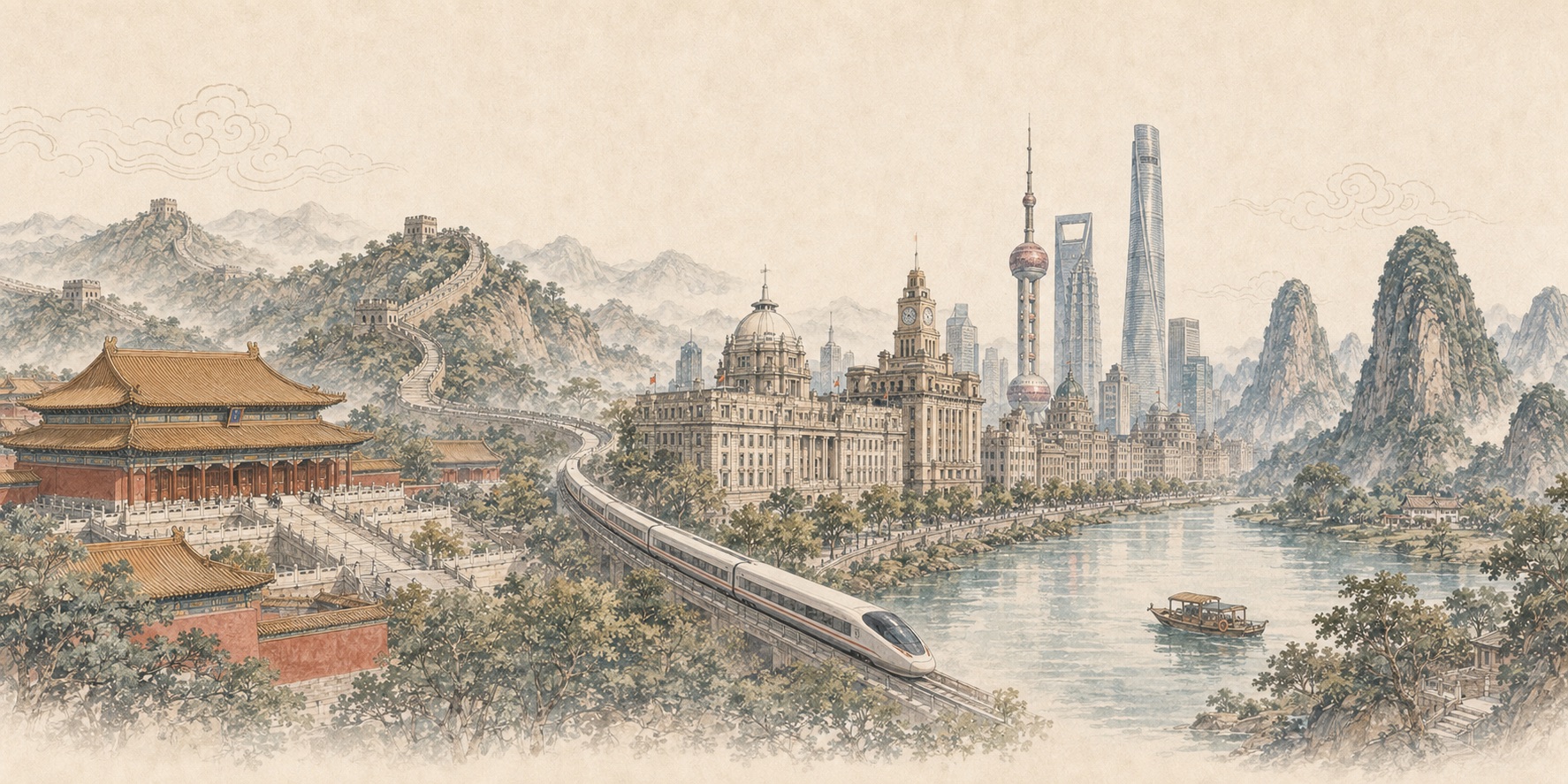
Beijing and Shanghai give a strong first contrast: imperial scale, the Great Wall, temples and hutong neighborhoods, followed by riverfront architecture, museums and modern urban rhythm. This is the cleanest short route.
Beijing, Xi'an, and Shanghai add a deeper historical layer, but the route includes two major transfer blocks. Nine to ten days is a more realistic starting point than one week.
A major city plus Guilin and Yangshuo works when landscape matters as much as monuments. Give that section at least three days, with four as the more useful default.
Plan the route before the daily checklist
Open-jaw international flights can reduce backtracking. Inside China, compare the complete transfer: station or airport travel, security, waiting, arrival transfer, and hotel check-in all belong in the itinerary.
Keep the first day light. Jet lag, payment setup, navigation, and a large unfamiliar city can make an ambitious arrival schedule collapse quickly.
Lock the trip-shaping bookings first
Do not book every small attraction before the route is stable. Start with the items that can force the order of your days.
Use the same passport or valid identity document details required by the official booking channel, carry the original document, and recheck every rule close to travel.
- International arrival and departure cities.
- High-demand, real-name attractions such as the Forbidden City.
- Long-distance rail or domestic flights.
- Hotels near the stations, neighborhoods, or early departures you actually use.
- Flexible museums, gardens, food walks, and optional activities.
What China Go can do next
China Go currently builds realistic previews one supported destination at a time. A multi-city guide helps you choose the sequence and day split; it does not pretend that the current planner automatically optimizes every intercity connection in one step.
Start with the city that has the most constraints. For many first trips, that is Beijing: reserve four days, choose your priorities, and see whether the pace leaves enough room for the next stop.
Start with one destination
Turn the route decision into a realistic preview
Beijing · 4 days · Culture · History · Architecture