
China trip planning guide
How many days do you need in China? Count the transfers first.
Decide whether 7, 10, 14, or 21 days fits your China trip, count transfer time honestly, and choose how many destinations to include.
Reviewed 2026-09-02
Quick answer
Choose the shape before the stops
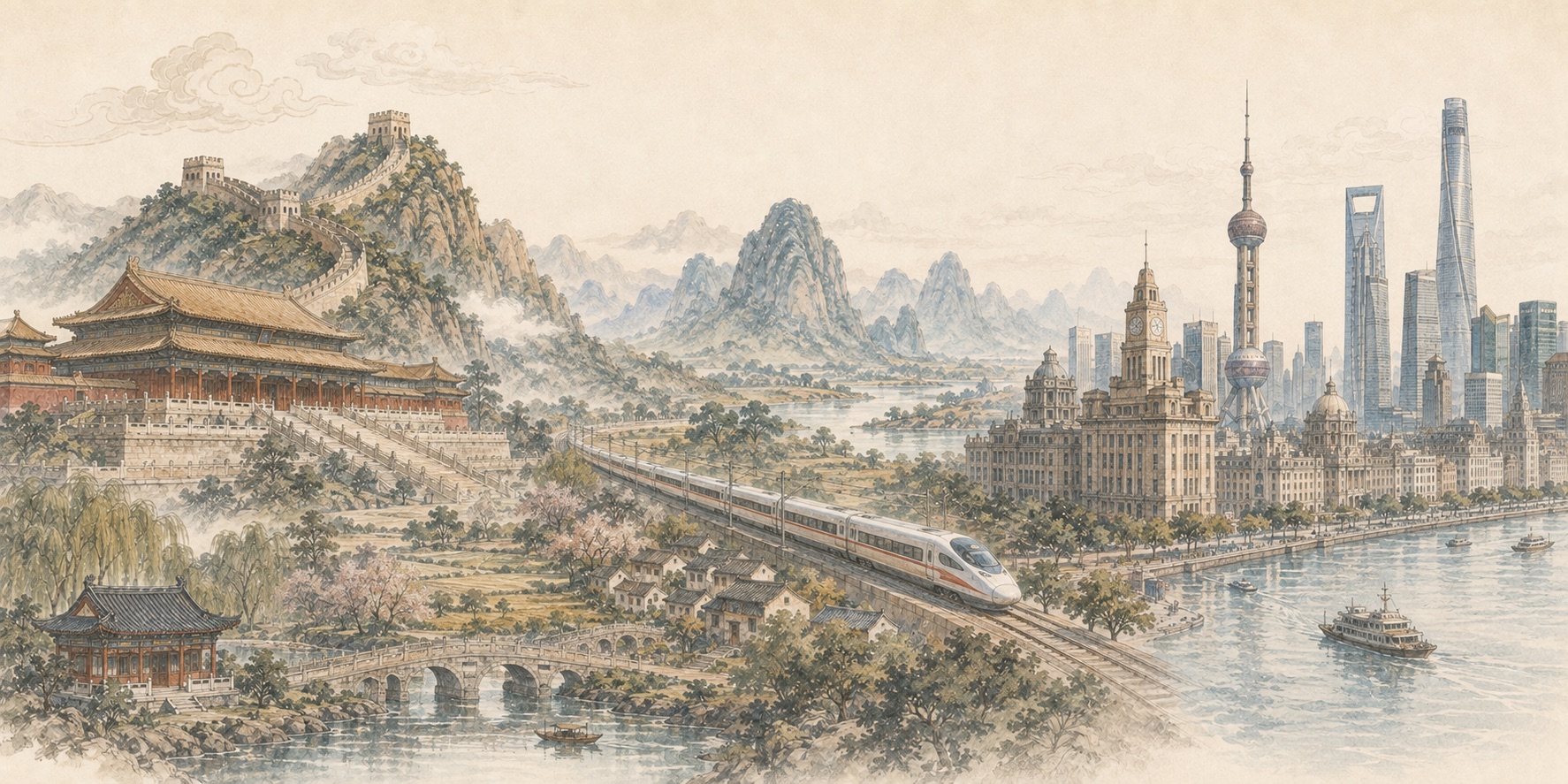
Choose ten days for two cities with depth, or fourteen days for three contrasting stops with more buffer time. Ten days across three cities is a faster trip with less room to recover from transfers. If you want a four-day nature section as well as two major cities, fourteen days is the more flexible starting point. Count arrival, departure, and transfer days honestly in either option.
- 7 days: one region or two major cities.
- 10 days: two cities with depth, or three at a fast pace.
- 14 days: three main stops at a balanced pace.
- 21 days: four or five stops with room for a nature region or weather recovery.
Seven days: make a clear choice
One week is enough for a meaningful first trip if you stop treating it as a national survey. Beijing can fill the week. Shanghai can anchor a Jiangnan week with Suzhou or Hangzhou.
Beijing and Shanghai can fit together, but each city becomes selective and the rail transfer consumes part of a day. Avoid adding a third distant city just because the fastest service looks short on a timetable.
Ten days: depth or a fast classic route
Ten days can support two comfortable bases, such as Beijing and Shanghai, or a faster Beijing-Xi'an-Shanghai route. For the three-city option, use nine to ten days as a practical lower bound and treat both rail legs as real itinerary blocks.
If nature is the priority, use a major gateway city plus three or four days in Guilin and Yangshuo rather than collecting three large cities with no recovery time.
Fourteen days: the most flexible first-trip range
Two weeks gives the trip room to show different sides of China. A common shape is three main stops with three to five days each, connected in one direction. Another is two major cities plus a four-day nature section.
Keep at least one buffer block for weather, a delayed transfer, laundry, a slower morning, or an experience you discover after arrival.
Twenty-one days: build regions, not a longer checklist
Three weeks can support four or five stops, but geography matters more as the route grows. Group neighboring places and avoid repeated returns to the same hub.
A trip might move from North China history to East China cities, then finish with a southern landscape region. It should not zigzag across the country to collect isolated highlights.
Useful day ranges for current China Go destinations
These are editorial planning ranges, not guarantees that every interest fits.
- Beijing: 3 / 4 / 5 days. Four is the useful first-time default.
- Shanghai: 2 / 3 / 4 days. Three adds a stronger neighborhood or museum layer.
- Guilin and Yangshuo: 3 / 4 / 5 days. Four gives the landscape section a useful shape.
- Chengdu: 2 / 3 / 4 days. Three balances pandas, food, and city life.
Use the three-question cut test
If two answers are no, leave the city for another trip.
- Does it add an experience the route does not already have?
- Does it follow the geographic direction of the trip?
- Will you trade a buffer day and a slower morning for this transfer?
Start with one destination
Turn the route decision into a realistic preview
Beijing · 4 days · Culture · History · Architecture